Building The Value Game: A Fun, Rewarding Task App for Kids and Their Parents
How can you make everyday responsibilities fun for kids — and less stressful for parents — through a shared, gamified mobile experience?
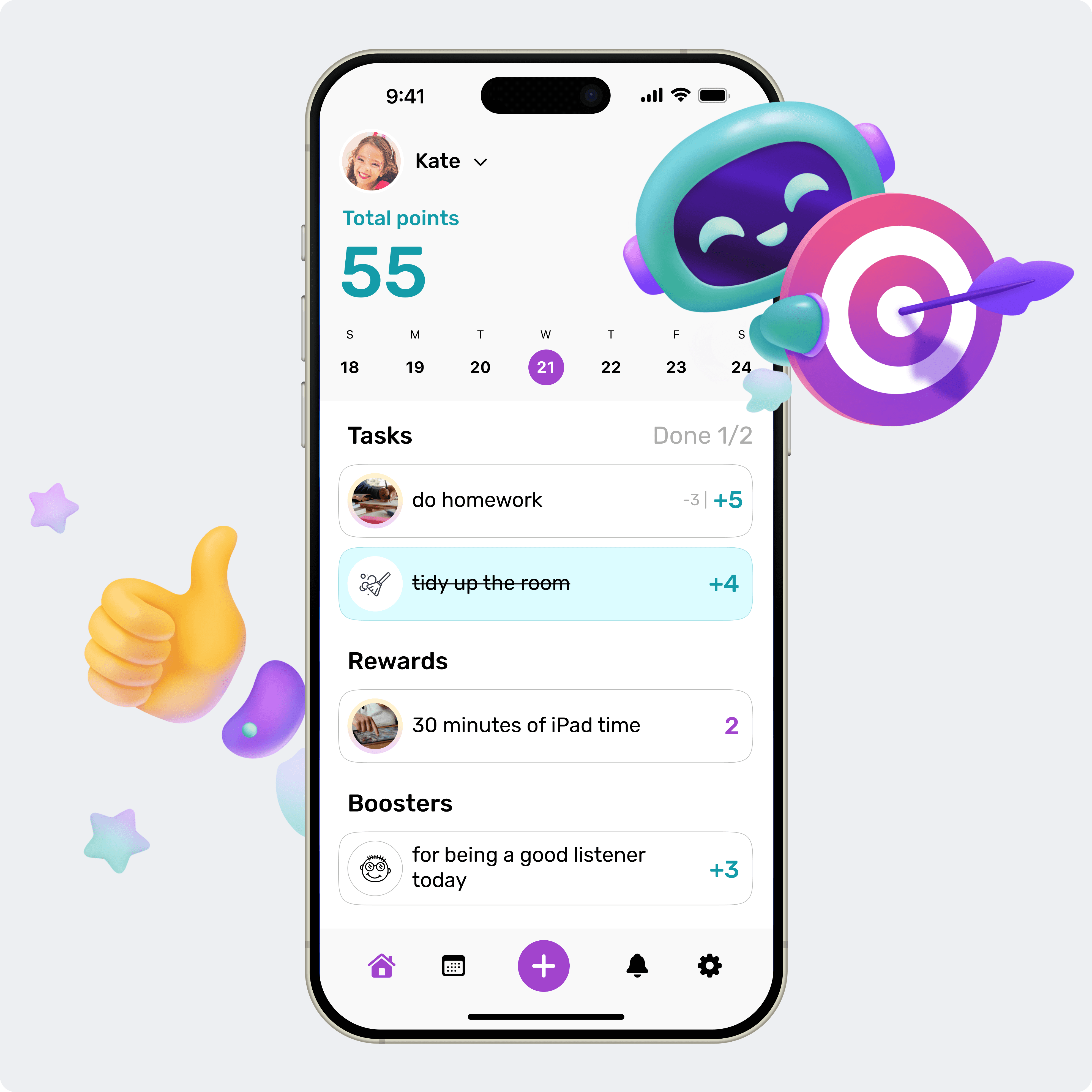
Designing a mobile task manager that empowers parents to motivate their children through positive reinforcement. As kids complete tasks, they earn points toward big goals and celebrate small wins. The app features two distinct versions — one for parents and one for children — to create a seamless, rewarding experience for the whole family.
year
2020-2021
Duration
8 months
my role
Senior Product Designer leading the design process from 0 —> 1
Team
2 Product Owners, Art Director, 1 Project Manager, 1 Engineering Manager, 1 Engineering Lead, 2 iOS Developers, 1 Illustrator, me
Platform
iOS
Made with
69pixels.
Challenge
What if chores didn’t feel like a battle — but a game everyone could win?
Parents want to build habits that last. Kids want to feel independent and rewarded. But in real life, this often breaks down: reminders turn into nagging, tasks get skipped, and motivation quickly fades. Research shows that only 28% of children complete chores without reminders (University of Michigan, 2014), and 89% of people feel more productive when tasks are gamified (TalentLMS, 2019).
My challenge was to design a mobile experience that transforms these daily moments of friction into something engaging and constructive for both sides.
The app needed to:
Help parents manage and reinforce positive behaviors
Give children a fun, intuitive system to build responsibility and save toward meaningful goals
Balance short-term wins with long-term growth
Deliver two distinct yet connected experiences — one for kids, one for parents — without overwhelming either
I wasn’t just building a task manager. I was building a bridge between structure and play, discipline and encouragement, parents and kids.
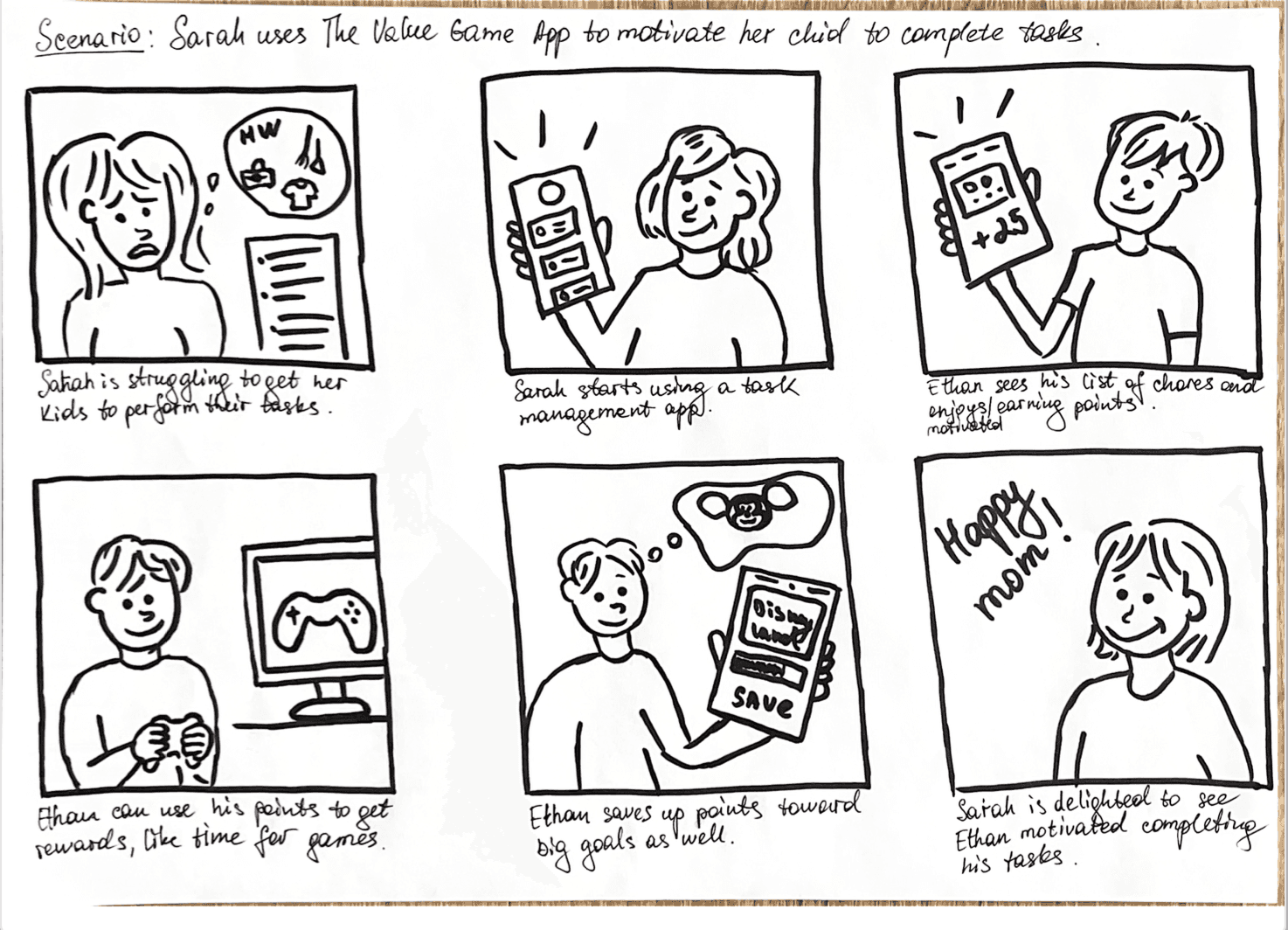
Rough sketches showing the problem and how the app might help fix it.
Status Quo
(0 —> 1)
When I joined the project, there was no existing product — just an idea and a hypothesis shared by two founders who were deeply passionate about helping families build better habits through positive reinforcement.
They envisioned a mobile app that would help parents foster responsibility in their children, while offering kids a playful, gamified way to engage with everyday tasks. At that stage, there were no wireframes, screens, or system logic — just early ideas of parents assigning tasks, kids earning points, and receiving rewards.
This was a classic 0 → 1 challenge. My job was to help them take that vision and translate it into a fully functional, user-friendly iOS app — from the ground up.
I worked closely with the founders to define the product strategy, design the dual experience for kids and parents, and prioritize features that could support real behavior change without overwhelming either audience.
Because we were starting from scratch, my early process focused heavily on foundational research, competitive analysis, and building a system that could grow with user feedback. Every design decision had to balance engagement for kids with clarity and control for parents — all while remaining lightweight, intuitive, and emotionally resonant.
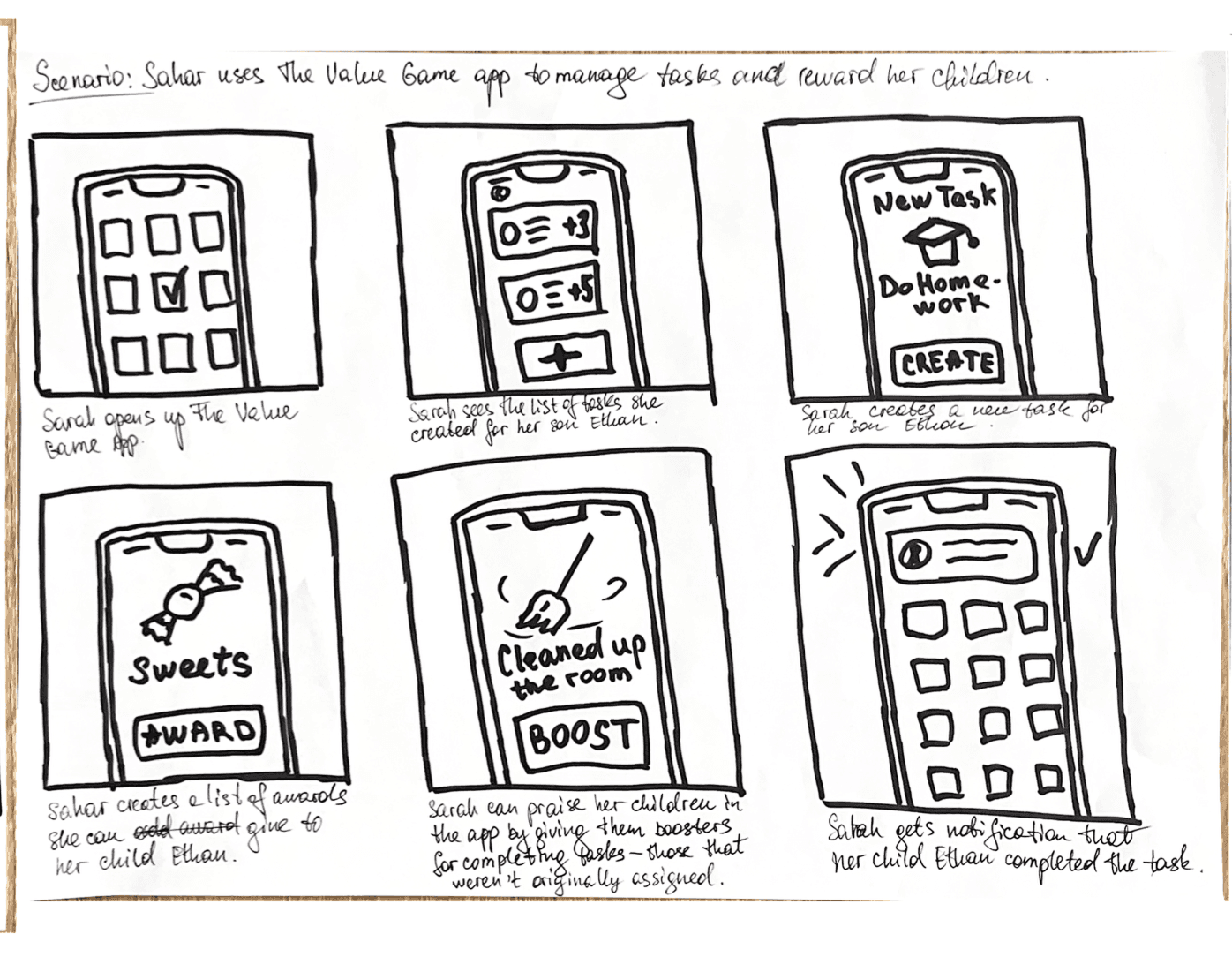
Rough ideas for how the parent version of the app might work.
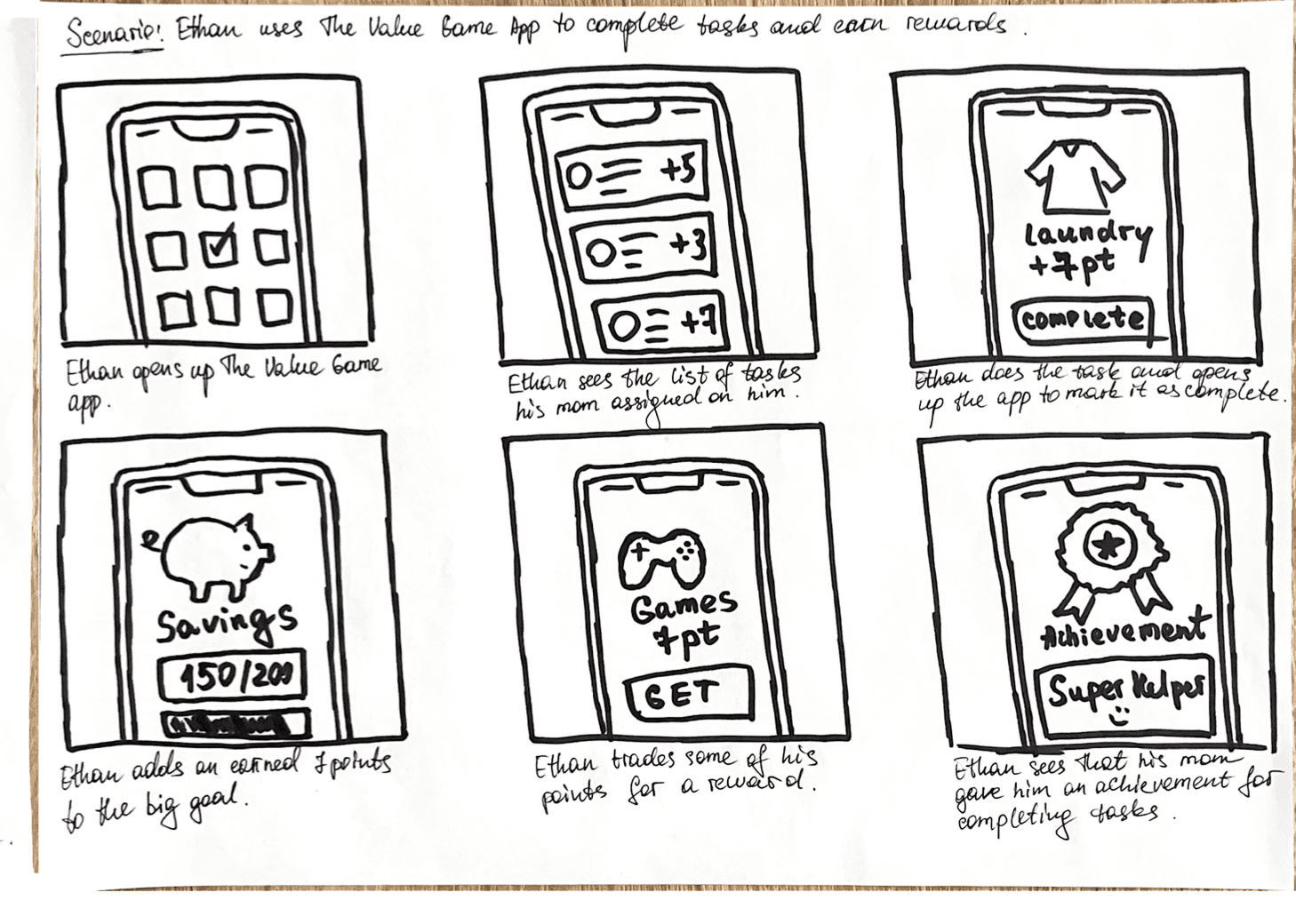
Early ideas for how the app could work for kids.
Market Analysis
At the time I began designing The Value Game in 2020, the digital landscape for task management and behavior motivation tools for children was surprisingly limited — and largely one-sided.
Through a competitive audit, I explored both direct and indirect competitors to better understand the landscape:
Direct competitors like BusyKid and Homey focused on chore tracking and financial incentives (digital allowance, payouts for completed tasks).
Indirect competitors such as ClassDojo, Khan Academy Kids, Epic!, and Habitica used gamification to reinforce learning, behavior, or habit formation in more educational or community-driven contexts.
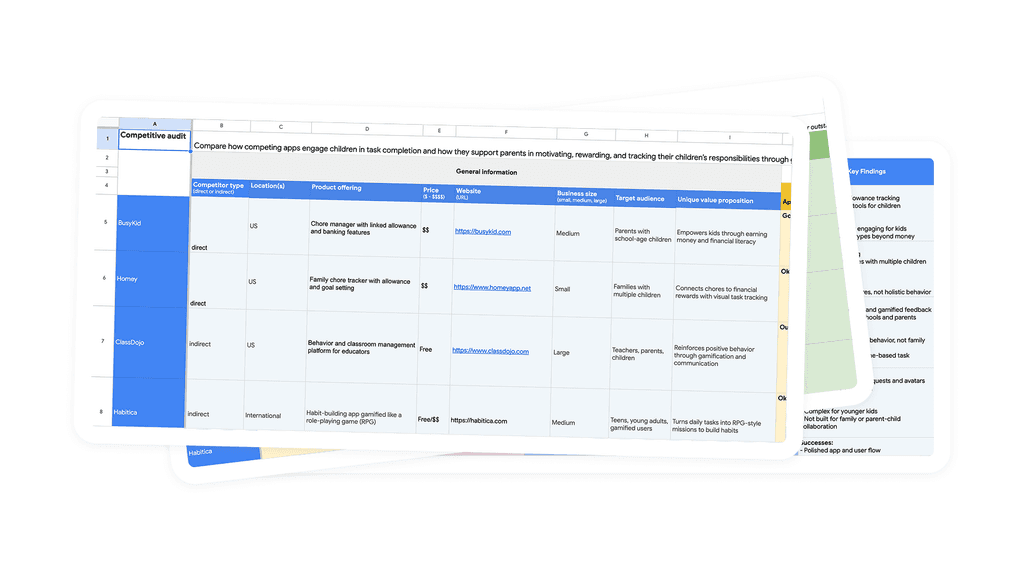
While these apps addressed task engagement or behavior tracking in various ways, my analysis surfaced a consistent pattern:
Most products were designed for parents first, treating children as secondary users.
The reward systems often relied on immediate or monetary incentives, with little support for long-term goal setting or intrinsic motivation.
Gamification felt superficial in many tools — lacking emotional feedback, personalization, or a real sense of progress from the child’s perspective.
Family values, multiple-child setups, and spontaneous positive behaviors were rarely supported in meaningful or customizable ways.
We saw a clear opportunity to do things differently.
Deliver a dual experience — one version for parents, one for children — optimized for each user’s needs.
Provide not only short-term rewards, but also encourage long-term goal-setting and emotional satisfaction through progress and achievement.
Offer flexible reinforcement through points, boosters, and privileges — not just rigid chore lists.
Create a positive loop where children feel empowered, and parents feel less stressed and more supported.
Foundational, Low-Resource User Research
With a tight timeline and no formal research team, I conducted a week-long, self-organized research sprint to better understand how families approach task management, motivation, and everyday routines.
To stay grounded in real needs while moving quickly, I combined two lightweight methods:
4 in-depth interviews: 2 parents (ages 32 and 38) and 2 children (ages 8 and 10)
27 survey responses from parents with kids aged 5–13, gathered via my personal network of friends, colleagues, and relatives
Even with this small-scale, low-resource approach, the insights were rich and highly actionable.
Most of surveyed parents said they struggle to keep their child consistently motivated to complete everyday tasks.
Most of the parents reward their kids, but only a few parents use any structured or trackable system — most rely on verbal praise or spontaneous privileges.
Many parents feel drained by constant reminders and wish for a tool that could help motivate their child more independently.
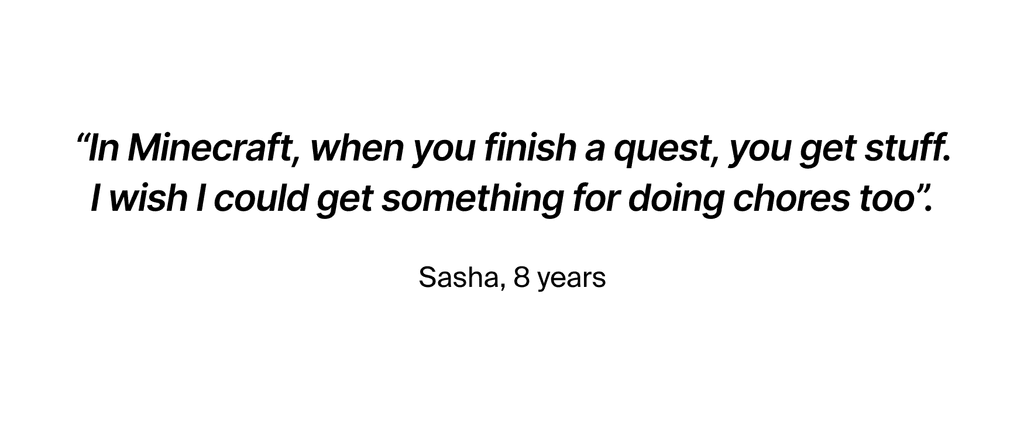
In interviews, children frequently compared real-life tasks to games — “In Minecraft, when you finish a quest, you get stuff. I wish I could get something for doing chores too.” This revealed a powerful insight: children are already wired to respond to game-like mechanics — they’re used to completing quests, earning points, and unlocking rewards. By mirroring this logic in everyday tasks, we could shift responsibility from “boring obligation” to “fun challenge.”
One parent reflected: “If I could motivate my kid the way a video game does, that would change everything.”
Initially, we assumed that points alone would motivate kids and that parents only cared about task completion, but we learned that gamification, tailored rewards, and behavioral encouragement are essential for both engagement and effectiveness.
These insights led us to define the app’s core strategy: a gamified system that supports children’s natural motivation patterns while easing the pressure on parents to micromanage tasks.
These insights led us to define the app’s core strategy: a gamified system that supports children’s natural motivation patterns while easing the pressure on parents to micromanage tasks.
Understanding Our Users: Personas
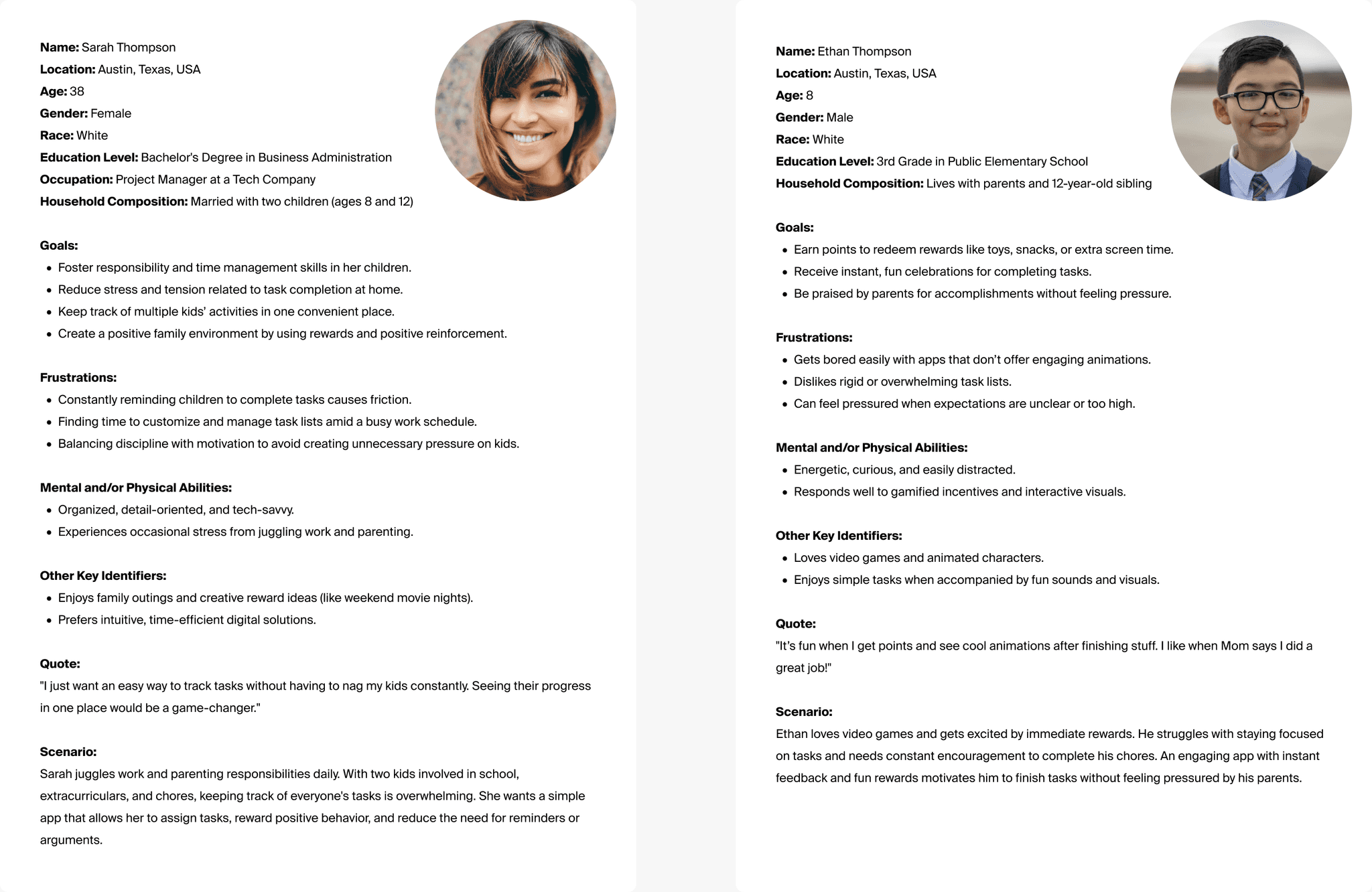
To stay grounded in real needs, I created two primary user personas based on foundational research:
Sarah, a busy, tech-savvy parent who wants a simple, low-stress way to help her kids build responsibility.
Ethan, her energetic 8-year-old son who thrives on fun, feedback, and small wins.
These personas guided every design decision — ensuring the app balances clarity and control for parents, with playful motivation and ownership for kids.
From Journey to Strategy: What I Learned
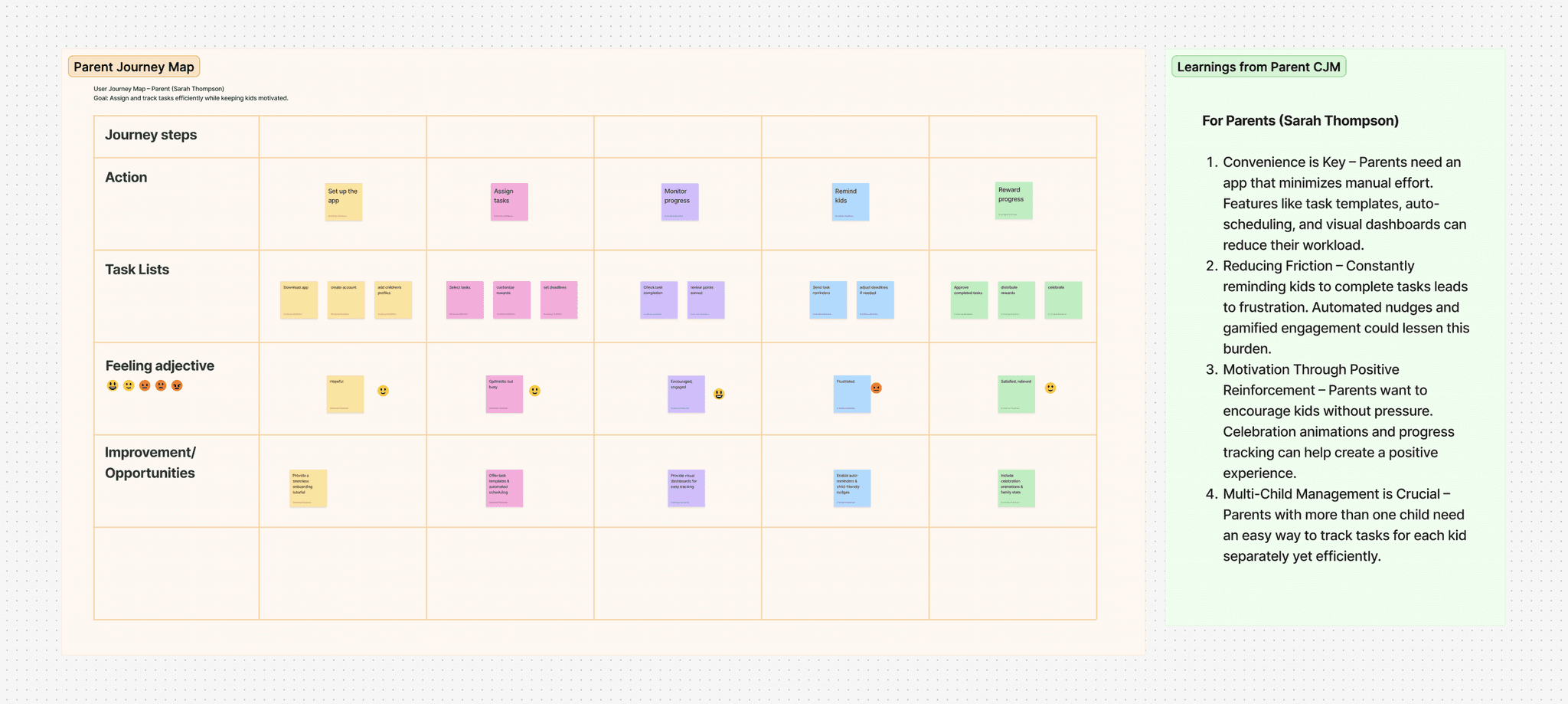
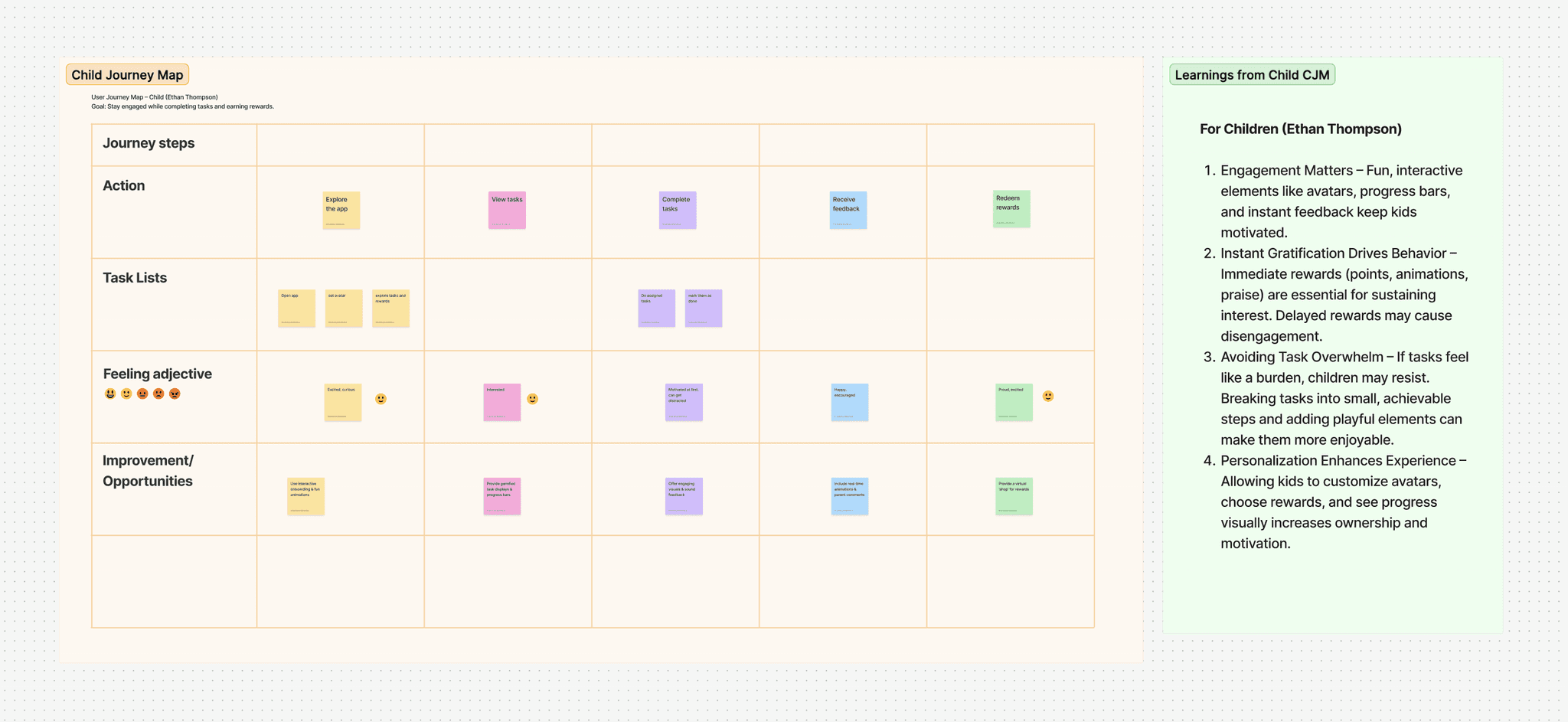
Mapping out Sarah’s and Ethan’s journeys revealed one essential truth: parents and children need very different things — but they’re both crucial to the product’s success.
Sarah, the parent, craves structure and simplicity. She’s tired of repeating herself and wants a system that helps her stay organized, reduce friction, and feel in control.
Ethan, the child, needs fun, freedom, and feedback. He thrives when small wins feel exciting and progress feels visual.
But I also uncovered something deeper: while children are the primary users of the app, parents are the decision-makers. If the experience doesn’t feel useful and effortless for adults, it won’t be adopted — no matter how engaging it is for kids.
I realized my job wasn’t just to design a task manager — I had to build a bridge between responsibility and play, between adult priorities and child motivation, between usability and delight.
That understanding shaped our product hypotheses:
For parents like Sarah:
If we provide an intuitive task management system with automated reminders and progress tracking, then parents will experience less stress and spend less time reminding their children about tasks.
For kids like Ethan:
If we incorporate gamification elements like points, rewards, and engaging animations, then children will stay motivated and feel excited to complete their tasks.
These hypotheses guided every design decision going forward — from interface structure to reward systems to how we balanced control and autonomy for each audience.
Prioritizing What Matters: Defining
the MVP
With a long list of exciting features on the table, we gathered as a team — designers, engineers, managers, and founders — to define what should go into the very first version of The Value Game.
Our goal? Focus on the core loop that would deliver real value fast:
Tasks → Motivation → Progress → Reward
We mapped every idea onto a single board — then made tough, research-informed decisions about what to build now, what to save for later, and what to leave behind.
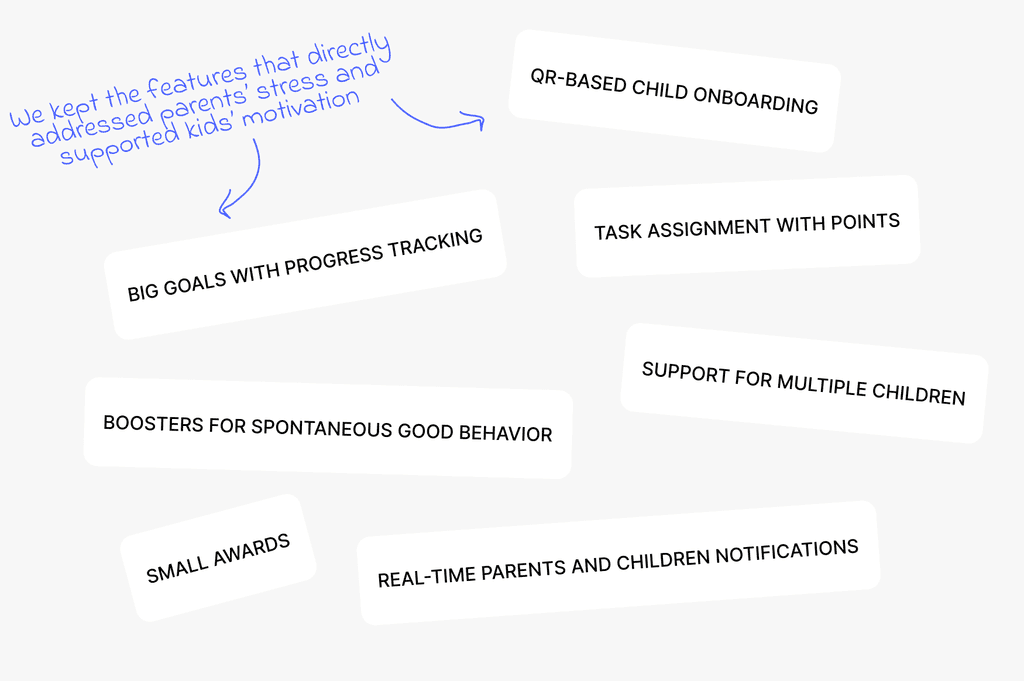
Included in MVP
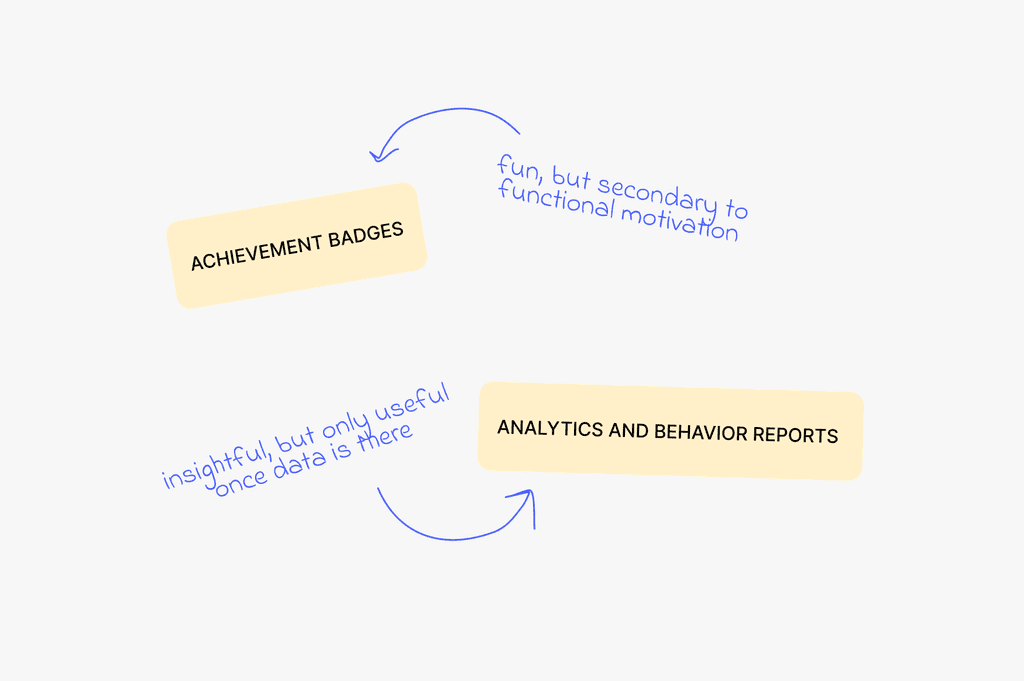
Moved to Backlog
Not Included
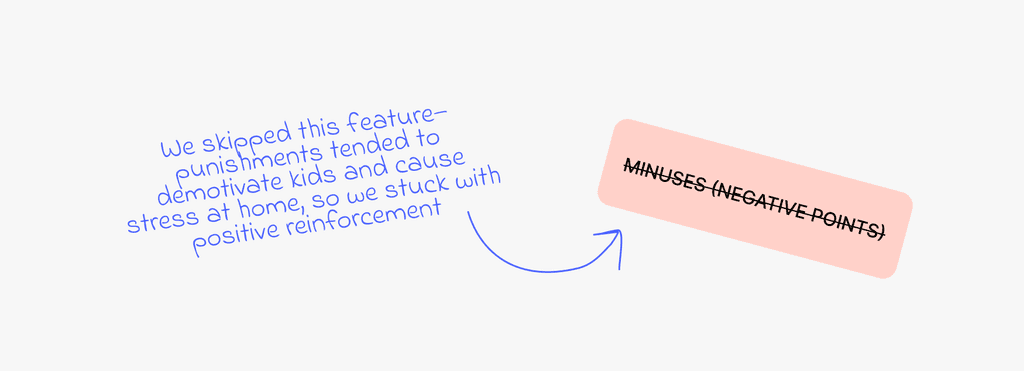
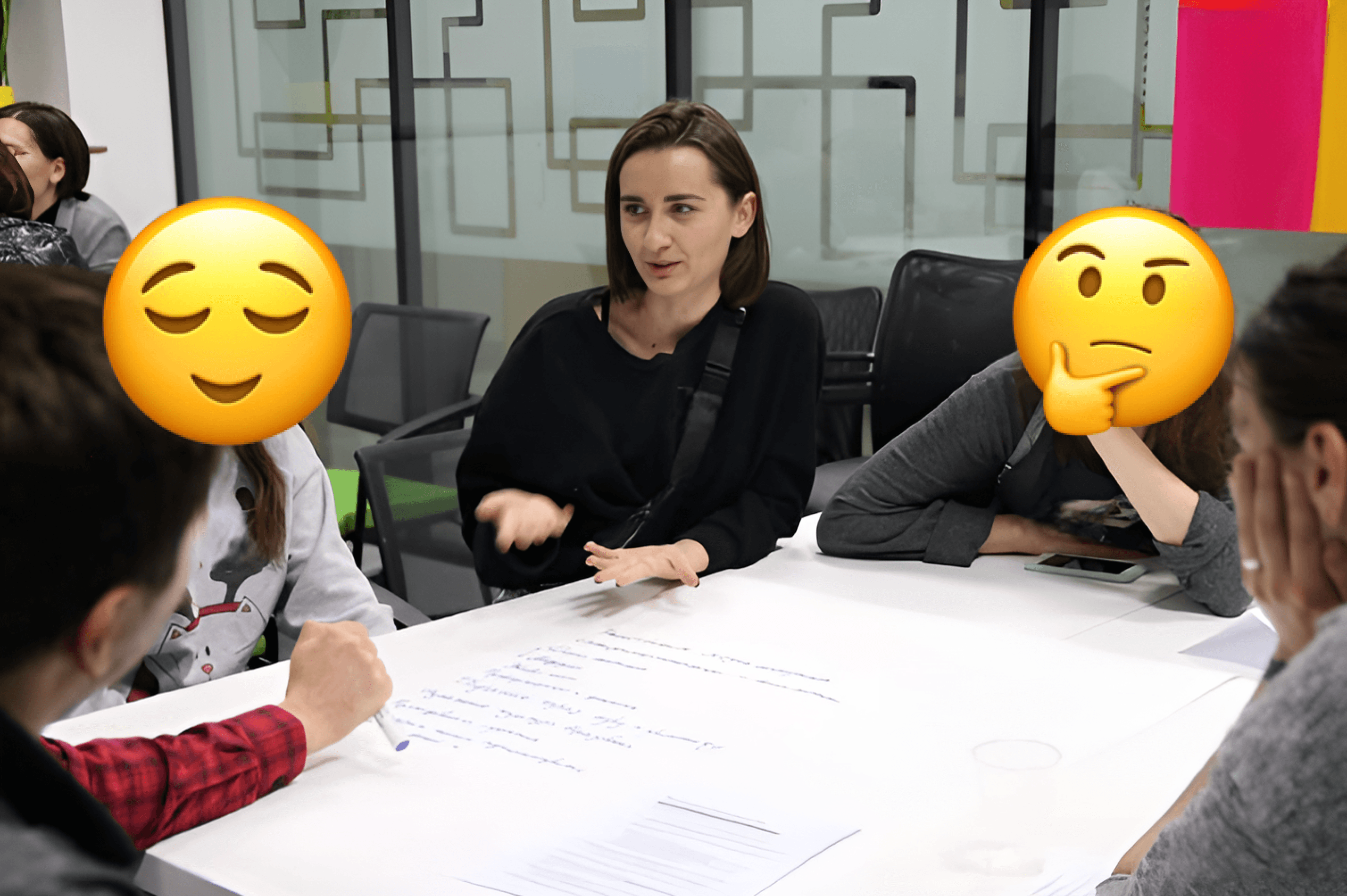
That's me saying I would hate an app that punishes me :)
Structuring
the app
Before jumping into screens, I began mapping the app’s core structure using sticky notes — literally on the wall of my bedroom. It was early 2020, the world was in lockdown, and like many others, I found myself working from home full-time. With no access to whiteboards or meeting rooms, my bedroom wall became mission control. I’d wake up staring at sticky notes, fall asleep thinking about user flows, and constantly tweak the layout between Zoom calls. You could say the information architecture became my unexpected roommate!!
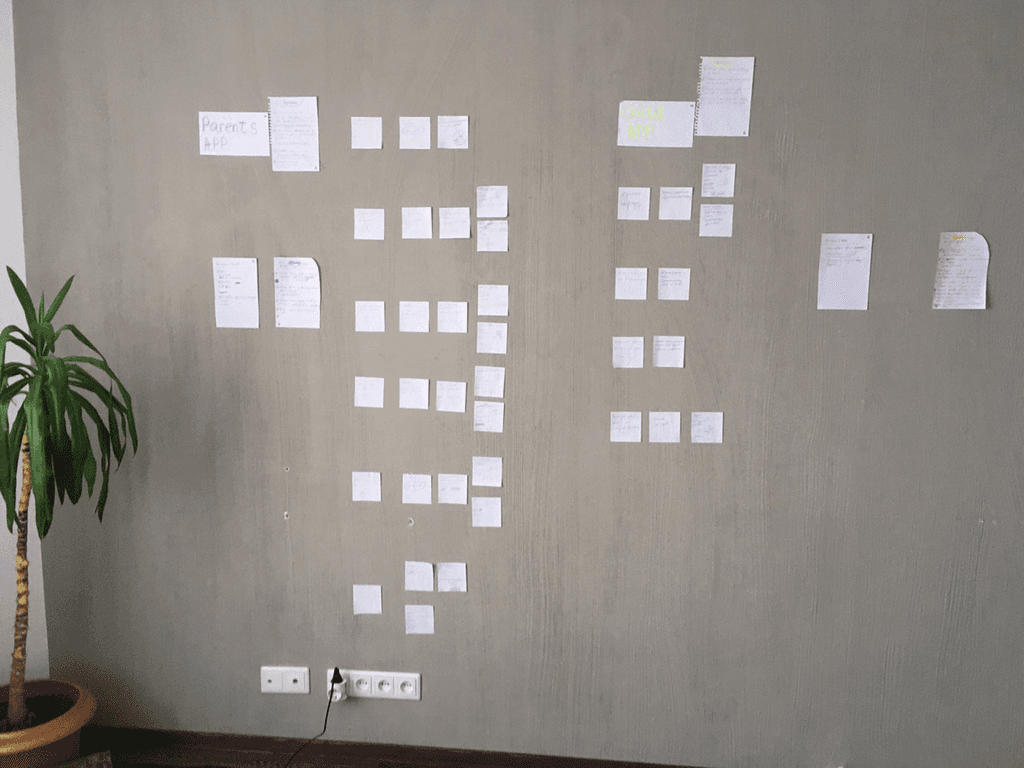
Covid lockdown decor: 30% IKEA, 70% app architecture :)
Once the system started making sense, I translated it into a digital format to refine the hierarchy and define the structure more clearly.
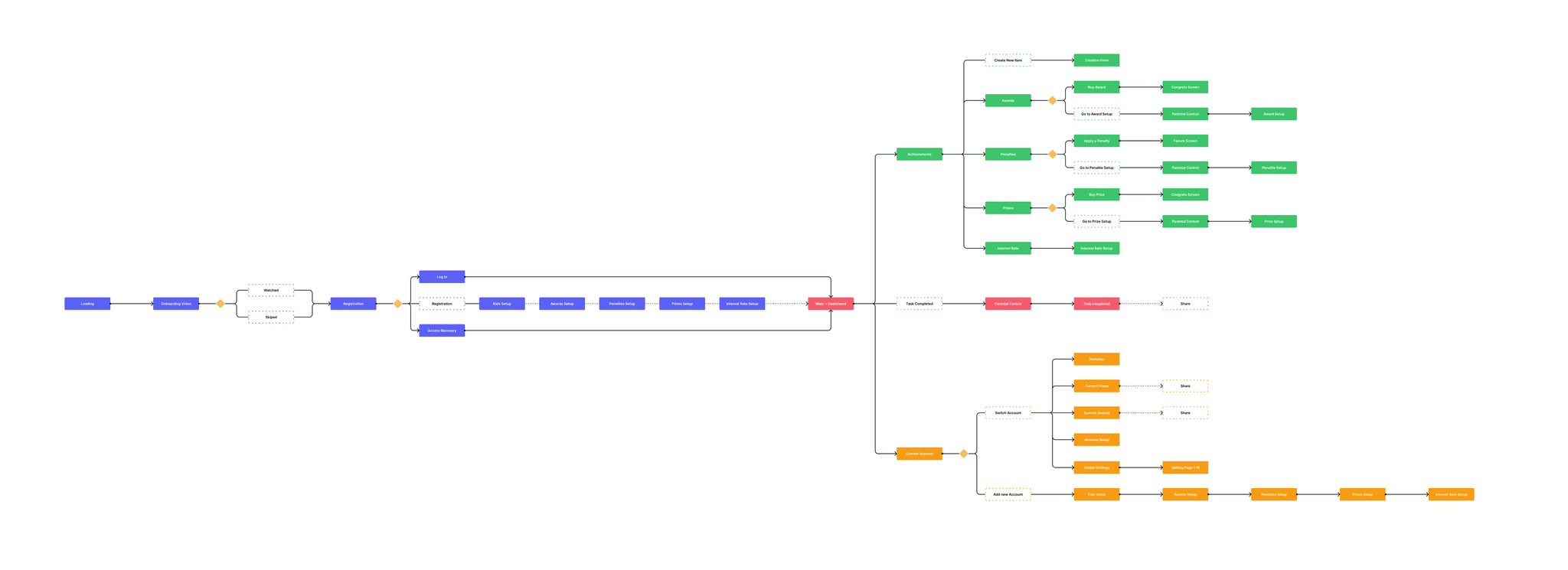
Flow Architecture: Parent & Child Views
From there, I moved into user flows — mapping how each type of user (parent vs. child) would navigate through tasks, goals, rewards, and settings.
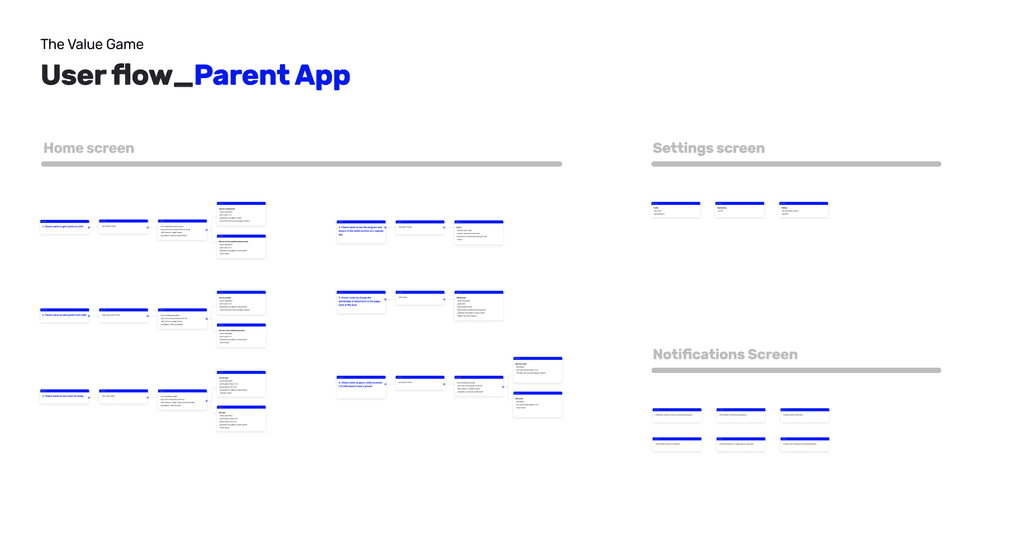
Mapping Sarah’s journey: from assigning tasks to celebrating wins.
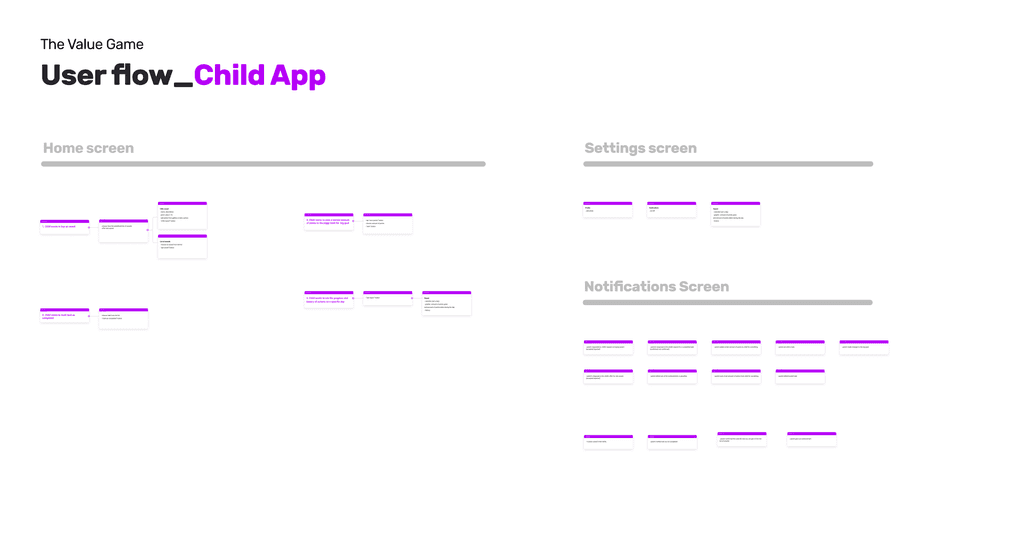
Ethan’s flow: see task → do task → earn, save, celebrate.
Mapping out the core user flows helped us turn early ideas — which until then lived mostly in conversations — into something more tangible. It allowed the whole team, from PMs to engineers, to align on key interactions before jumping into design or development.
Flow Architecture: Parent & Child Views
Since parents are the primary decision-makers when it comes to choosing tools that help manage their children’s tasks and motivation, I decided to focus on their experience first. That meant starting with the parent-facing prototype — designing the homepage with their goals, behaviors, and mental models in mind.
I created three layout prototypes and ran usability tests with five parents to see which version felt the most intuitive, motivating, and clear.
To compare layouts fairly, I focused on:
First impressions – Which layout feels the most welcoming and easy to understand?
Ease of navigation – Can users quickly find what they need?
Task flow clarity – How well does the layout support daily parent actions?